
THRIVING TOGETHER → MODULE 2
MODULE 2 –
The Vital Conditions for Well-Being

Seven Vital Conditions for Community Health and Well-Being
Vital conditions are the foundational factors people and communities need to thrive, such as basic needs for health and safety, humane housing, meaningful work and wealth, lifelong learning, a thriving natural world, and reliable transportation.
The vital condition of belonging and civic muscle is central to all of these. Belonging means feeling part of a community, being embraced for who you are, and being valued for what you bring. It also builds civic muscle—the power of people in a diverse, multiracial society to work across differences as stewards of their lives together.
Each condition plays a role in shaping health. They are interconnected and often influence one another.
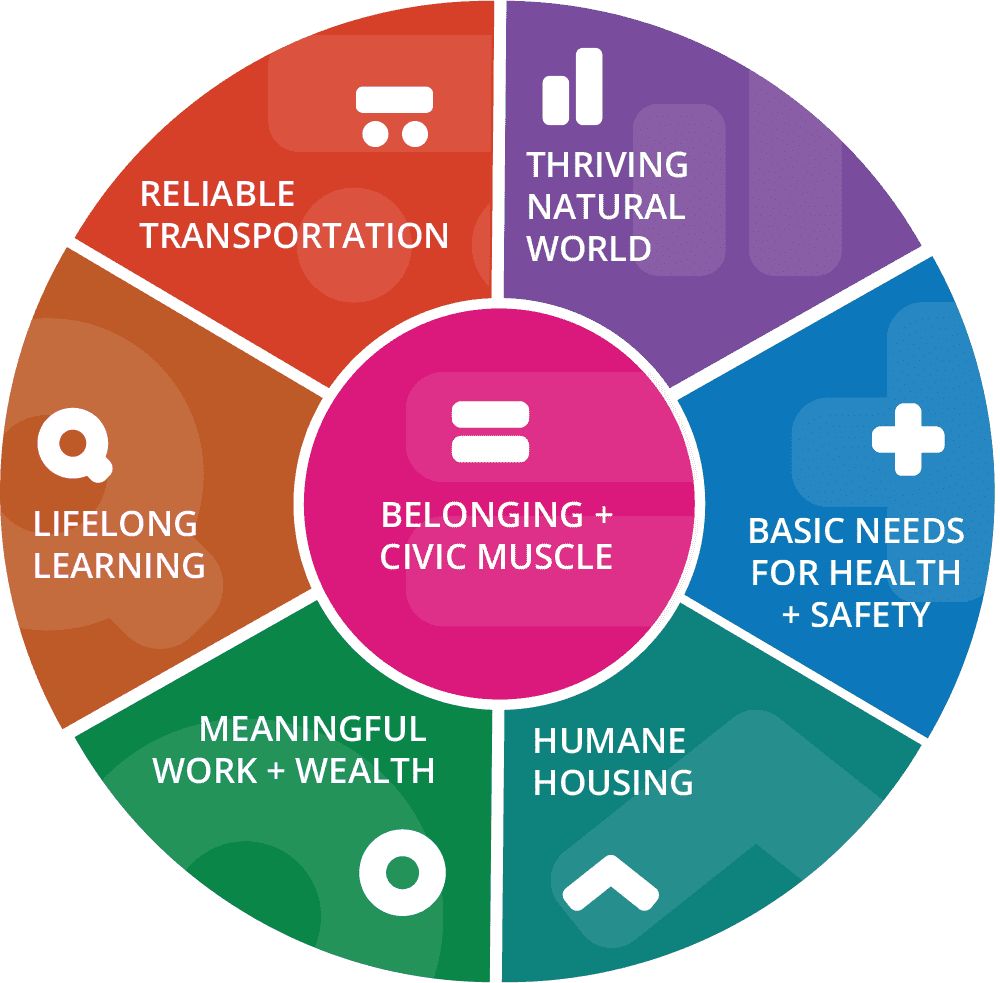
Belonging and Civic Muscle
Sense of belonging and power to shape a common world
Reliable Transportation
Reliable, safe, and accessible transportation
Thriving Natural World
Sustainable resources, contact with nature, freedom from hazards
Lifelong Learning
Continuous learning, education, and literacy
Meaningful Work + Wealth
Rewarding work, careers, and standards of living
Basic Needs for Health + Safety
Basic requirements for health and safety
Humane Housing
Humane, consistent housing
Individual programs and projects are not enough to create a system built for well-being and justice. However, a unifying movement across sectors can:
- AEstablish a system that is equitable by design
- APrioritize the vital conditions everyone needs to thrive
- AEnsure mutual accountability for expected outcomes

IN PRACTICE
Momentum Growing for Ensuring Vital Conditions for All
A growing cadre of organizations now explicitly focuses on establishing vital conditions. This includes changemakers from all walks of life and scores of agencies across the federal government. For example, organizing around vital conditions moves the agenda of social determinants agenda into broader action. With few exceptions, those who use the vital conditions framework say that it is clear, concise, and built for concerted action.
At the national level as of August 2024, more than 44 departments, agencies, and institutes across the U.S. government published a federal interagency plan for equitable long-term recovery and resilience: People and Places Thriving: The Federal Plan for Long-Term Resilience. The federal plan points the way toward a just transition for multiracial well-being. It does not require new appropriations or authorities, only the will and wherewithal to bring these recommendations to life.
“Knowing that this framework is being embraced by other national partners is encouraging. Love the power of collective thinking that this facilitates.”
-Family Health Centers
FEDERAL PLAN USES THE VITAL CONDITIONS FRAMEWORK
In November 2022, the federal government released its interagency plan for Equitable Long-Term Recovery and Resilience. With commitments from more than 44 federal agencies, this landmark plan outlines a whole-of-government approach to unlock America’s full potential for all people and places to thrive together. It orients federal action around vital conditions that are essential for all people and places to thrive.
how the conditions work together
Understanding these connections can help identify opportunities to address multiple conditions at once.
Community Health Centers’ Role in Expanding Vital Conditions
CHC leaders often face significant challenges in fully embracing their roles as stewards and effective agents of system change. Even those with the best intentions and a willingness to improve regional health often find themselves outside their realm of experience or lacking the necessary tools to foster a shared vision with community partners and develop a solid plan for investing in community health.
While CHCs often center their work on urgent services and basic needs, the sector is a key partner for strengthening our communities. Vital conditions are distinct and indispensable and form an interdependent system. Investing in one vital condition will strengthen the entire system, community, or region. CHCs are uniquely positioned to expand all vital conditions.
Put What You’ve Learned Into Practice
TEAM REFLECTION QUESTIONS
Which of the Vital Conditions for Health and Well-Being are most visible in your community today? Which feels least present?
Where do you see patterns of thriving, struggling, and suffering connected to these conditions?
Which vital conditions does your organization influence most directly? Which are less connected to your current work?
TRY THIS WITH YOUR TEAM
- AReview the list of Vital Conditions and discuss what each one looks like in your community
- AIdentify examples of where these conditions are strong and where they are lacking
- AMap current programs, partnerships, or efforts to the Vital Conditions they support
- ADiscuss which conditions may require stronger partnerships or new approaches
Explore resources and learn more
WHAT WE’VE LEARNED
Use these prompts to explore this concept in practice.
- NThe Vital Conditions for Health and Well-Being describe the essential conditions every community needs to thrive
- NThese conditions are interconnected and shaped by policies, systems, and community context
- NBelonging and Civic Muscle plays a central role in strengthening and sustaining all other conditions
- NImproving health outcomes requires attention to these broader conditions, not just individual services